Every year, we hear about the “next evolution” of CRM. And to be fair, 2026 does bring some genuinely meaningful shifts.
Artificial intelligence is more capable. Systems are more connected. Data can move faster and farther than ever before.
Here’s the uncomfortable truth I see again and again in real businesses: most CRM systems still fail for very old, very human reasons. Not because the software isn’t advanced enough, but because the basics were never done well in the first place.
While we talk about what’s new in 2026, we need to make sure we’re all talking about the same foundation for success.
The 2026 Plain English CRM Trend Cheat Sheet
1. CRMs are taking action, not just tracking activity
In the past (let’s just say through 2020-ish), CRMs mostly acted like filing cabinets. They stored notes, contacts, and activities, but humans still had to decide what to do next.
In 2026, AI and advanced technologies continue to be embedded more and more into systems. CRM is no different, and they are increasingly capable of taking action for you. That might look like:
- Automatically drafting follow-up emails
- Suggesting the next best step with a customer
- Creating tasks or reminders without someone manually entering them
This is helpful… BUT… only if the system knows what’s actually happening. If the data is wrong or incomplete, automation just helps you make mistakes faster.

2. One shared customer record is becoming the expectation
This phrase gets thrown around a lot, so let’s demystify it.
A unified customer record simply means this: everyone in your organization is looking at the same version of the truth about a customer.
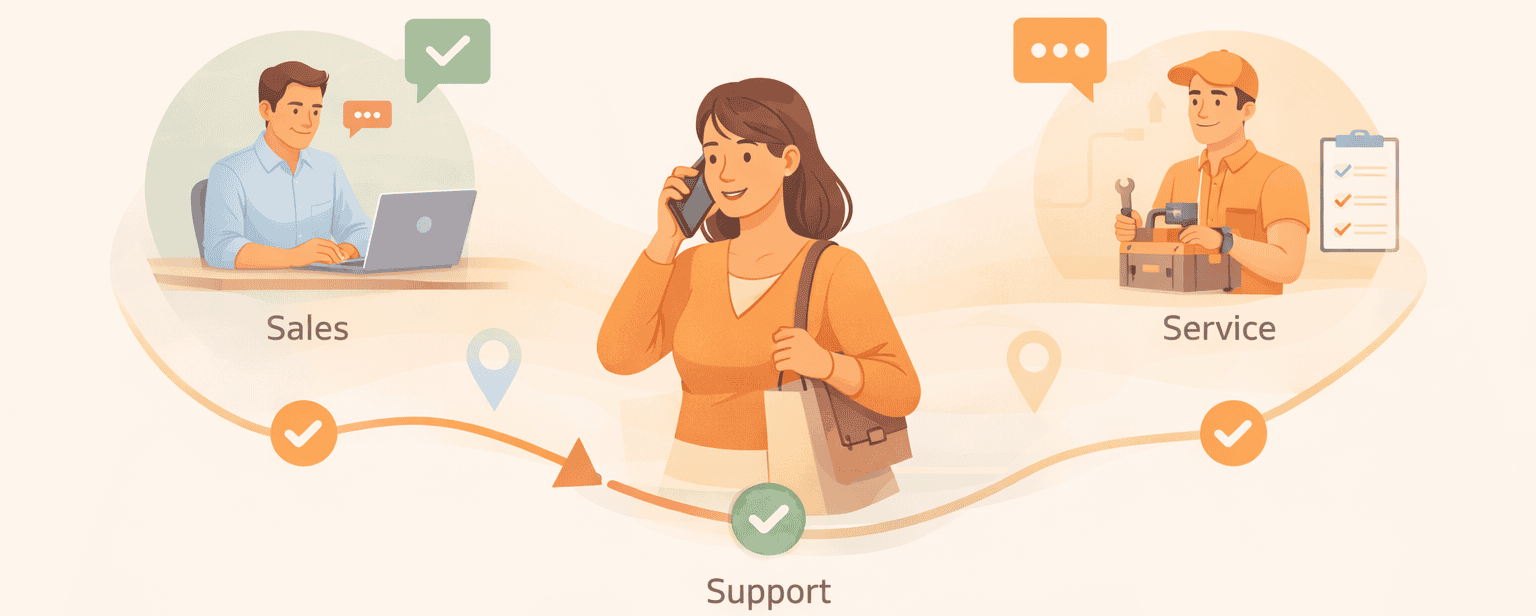
Sales, service, accounting, and operations are no longer working from separate systems that don’t talk to each other. When something changes in one place, it updates everywhere else. Without this, teams spend time reconciling spreadsheets, arguing about data accuracy, or re-entering the same information multiple times. With it, work flows more naturally.
This idea shows up consistently in research and guidance from organizations like Gartner and Forrester, especially as systems become more interconnected and automation increases. It becomes even more important as the number of transactions increase since scale acts as an amplifier.
“Scale as an amplifier” cuts both ways. A 5-minute workaround done two to three times a day isn’t a big deal. That same 5-minute problem scaled up to 200-300 occurrences in a day on the other hand is drastically more painful.
3. Automation, AI, and trendy tools are only as good as the data underneath it
Let’s be frank. Talking about clean data isn’t exciting. It doesn’t demo well in a board meeting, and no one walks out of a leadership offsite energized by a discussion about naming conventions, required fields, or duplicate records.
But here’s the reality: clean data is no longer a background concern. It’s the price of admission.
The new tools everyone is excited about, whether it’s automation, AI recommendations, or systems that prompt people on what to do next, all depend on data being accurate, consistent, and trustworthy. If the inputs are messy, the outputs won’t just be wrong, they’ll be confidently wrong.
That’s where things get dangerous.
When automation is built on shaky data, teams stop trusting the system. They ignore recommendations. They second-guess insights. And before long, the “smart” CRM becomes just another place people are told to update, rather than a tool that actually helps them.
Clean data isn’t about perfection. It’s about reliability. It’s about knowing that when the system suggests an action, surfaces an insight, or triggers a workflow, it’s doing so based on information people believe in.
4. Personalization is assumed, not impressive
My old boss and mentor, Darin Steward, used to use the concept of ordering Levi’s jeans online. The level of customization you could achieve was astounding. Burger King’s slogan of “Have it your way.” That entire concept of customized experiences has achieved a whole new level in 2026.
Customers now assume companies will remember who they are, what they bought, preferences, and what matters to them. They want to be heard and understood without having to re-explain themselves.
CRMs in 2026 are better at tailoring messages, reminders, and experiences. They’ll also provide a consistent consolidated experience, but there’s a tiny asterisk to all of it. Personalization only works when:
- Records are accurate
- Fields are filled in consistently
- People trust what they see on the screen
Get those three things wrong and personalization becomes awkward, incorrect, and borderline offensive to your customers and prospects. Operational discipline and diligence needs to be weaved into how your teams operate at a transactional level to ensure consistently positived, tailored experiences can be brought to each customer interaction.
5. Less typing and fewer clicks matter more than new features
CRMs are clearly trying to solve a real problem: people are tired of spending their days on administrative work.
Speech-to-text still hasn’t become second nature for most teams, so instead you’re seeing more practical improvements. AI-assisted text prediction helps people write notes and follow-ups faster, without starting from scratch. At the same time, CRMs are getting better at pulling in publicly available customer information automatically, reducing the need for manual research and data entry.
The goal isn’t to replace people. It’s to remove the small, repetitive tasks that quietly drain time and energy. When effort goes down, adoption goes up.
6. People-first design is becoming a differentiator
You’ll hear a lot of software vendors talk about “new experiences,” and that wording isn’t accidental. It’s a response to a hard-earned lesson: CRMs that fit how people actually work see higher adoption and better outcomes than feature-rich systems that look impressive but feel exhausting to use.
For years, CRM design prioritized capabilities over usability. The result was cluttered screens, endless fields, and workflows that made simple tasks feel heavy. That’s changing.
Publishers are now redesigning CRMs around clarity and flow, assuming there should be less to look at, not more. Better user experience means fewer distractions, smarter defaults, and systems that guide people instead of overwhelming them.
The shift isn’t about dumbing software down. It’s about respecting people’s time and attention, which is ultimately what drives consistent use and real value.
Why Most CRMs Still Struggle Today
Despite advances in technology, most CRM challenges come down to the same core issues: messy data, overly complex implementations, trying to solve everything at once.
Systems designed for reporting instead of people.
These problems don’t get solved by adding more features. They get solved by focus, restraint, and thoughtful design.
What actually works - do these things before chasing trends
If you want new CRM capabilities to matter, consider these tasks as a way to enhance or solidify the foundation that you’ll start from:
- Clean the data first: Decide what fields matter, who owns them, and what “good” looks like. Each field must provide a direct value – not just be a great way to capture a data point. If it doesn’t add value to the larger picture – get rid of it.
- For new CRM projects, limit the initial scope: The biggest reason why most CRMs fail is the initial scope. It’s all too easy to get excited about transformation, efficiency, and growth. Stay grounded and focus on solving two or three critically painful problems well. Once you get those solved effectively and the users are adopting the system, add one or two more things to tackle. AKA: build and scale on success, not failure.
- Design for the people using it: If you haven’t actively included the people who will use the CRM into the conversation – do so now. Fewer clicks, less typing, and clear workflows are great. But getting people involved in the design while also giving them a powerful feeling of control of the system they use is powerful. Not only will they get what they’ve always wanted, but they’ll be phychologically invested in seeing it succeed.
If you do those things well, not only will people want to use the system, but you’ll be well positioned to discuss the latest advanced features that are now available for your CRM.
So... What does all of this mean?
CRM in 2026 will absolutely be more powerful. We’ll see a lot more with AI, but a depth that’s less obvious and more subtle in how it engages with data to present tasks, quietly handle administrative burden, etc.
But power without discipline just creates noise. The companies that succeed won’t be the ones chasing every new capability. They’ll be the ones that follow these rules:
- Respect the fundamentals: before you get carried away with flashy bells and whistles, handle the basics. Create a foundation of success before trying to go after the shiny things most publishers are saying you “must have right now!”
- Make systems easier, not heavier: user adoption is critical to long-term success with CRM. Give your people a tool that they will want to use… and they will!
- Treat CRM as a support tool for people, not a control mechanism: there’s a fallacy that still exists where a simple CRM implementation magically creates layers of visibility that allows for excessive data points for decision making. While true… it’s not magic. It’s getting people to use the system. Make sure your CRM empowers your teams – and most importantly – doesn’t punish them or make it feel like they’re living in George Orwell’s “1984” novel.
Get the basics right, and the trends in any CRM can actually work for you instead of against you.