If you talk with teams inside growing organizations, you’ll hear a familiar tension.
People aren’t against better tools… they’re against tools that make their work harder.
When frustration follows a new system rollout, it’s often described as resistance to change or burnout. In practice, that framing misses what’s actually happening.
Most digital transformation fatigue isn’t a people problem.
It’s a design problem.
Fatigue Shows Up Where Friction Lives
People don’t get tired of meaningful work. They get tired of unnecessary friction or systems that require several monitors with constant diligence to ensure they’re not missing anything.
One thing I look for when in a new environment… how many monitors do employees have? If it’s more than two, that’s not a good sign. Mainly because it’s an indicator that their job requires multiple tools to use at any given time (mandating a need for multiple screens).
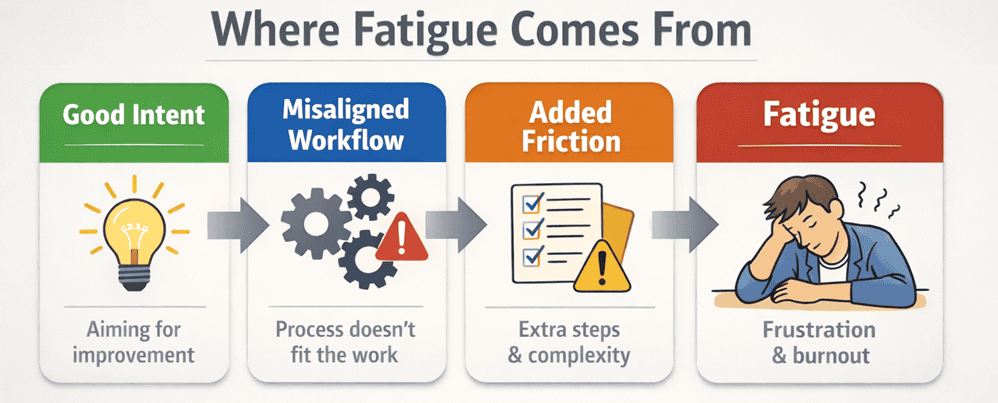
They get tired of navigating systems that don’t reflect how work actually happens. They get tired of entering the same information more than once. They get tired of small workarounds quietly becoming part of the job.
That kind of fatigue isn’t a lack of adaptability. It’s a reasonable response to systems that create busyness without returning much value.
And in most cases, those systems weren’t introduced carelessly. Leadership teams invest in software because they want better visibility, better decisions, and more consistency. Those goals make sense.
The disconnect usually appears when the design of the work itself isn’t examined with the same care as the software meant to support it.
The Hidden Cost of “Just a Few Extra Steps”
Administrative work isn’t the enemy. Some of it is necessary, and some of it benefits from human judgment.
The problem is accumulation.
A few extra fields here.
A manual step there.
A spreadsheet kept “just in case.”
Individually, these don’t feel significant. Together, they consume attention and energy in ways that are hard to measure but easy to feel.
When systems add more steps than they remove, people adapt. They always do. But adaptation has a cost, and over time that cost shows up as frustration, slower work, and disengagement.
Good design doesn’t eliminate responsibility. It removes unnecessary burden while leaving room for the work that actually requires context, care, and judgment.
Why Training Often Misses the Mark
When fatigue becomes visible, the default response is often more training.
More documentation.
More walkthroughs.
More reminders.
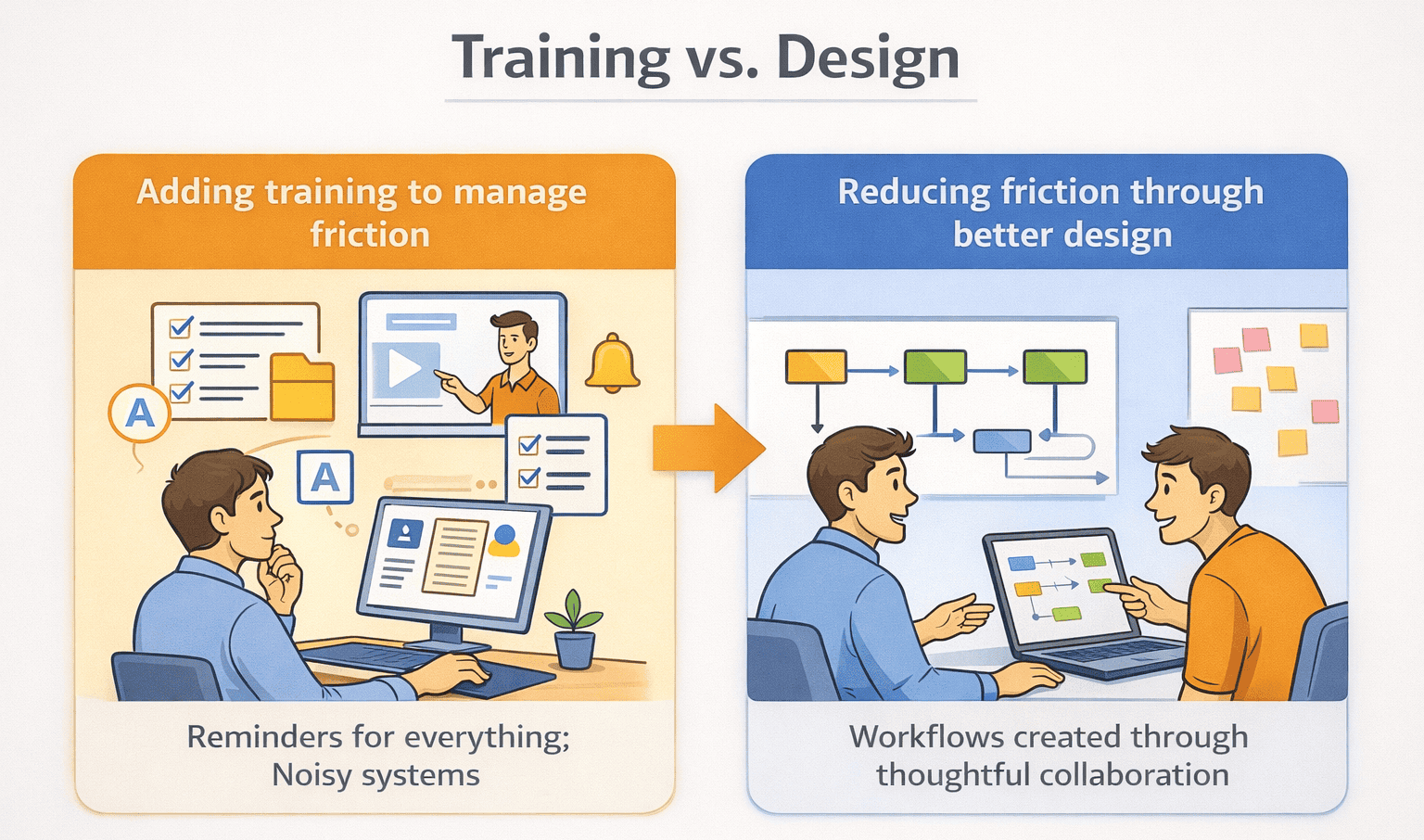
Training helps people understand how a system works. It doesn’t change how the system feels to use.
If a tool needs constant explanation, that’s usually a signal that the workflow doesn’t align with how people think or operate. No amount of training can fully compensate for that mismatch.
Systems that fit the work tend to require less instruction, not more.
Why Training Often Misses the Mark
There’s a difference between collecting requirements and actually listening.
Requirements focus on what information needs to be captured. Listening focuses on how work moves through the organization, where it slows down, and where human judgment matters.
When the people doing the work are meaningfully involved, systems tend to land differently. Adoption feels less forced. Feedback becomes more useful. Trust grows naturally as they feel included as a part of the process and not part of something that’s being done to them.
This isn’t about designing for people.
It’s about designing with them.
That collaboration doesn’t undermine leadership’s need for insight. It strengthens it. Systems people trust are systems people use consistently, which leads to better information and better decisions.
Not Everything Should Be Automated
One of the quieter mistakes in digital transformation is assuming that success means removing as much human involvement as possible.
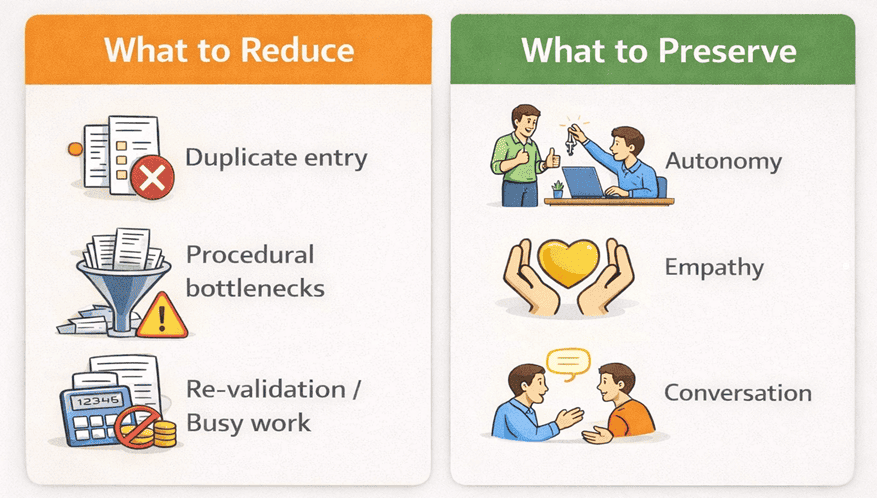
Some work is inherently human. It requires empathy, context, and accountability. Trying to automate those moments often strips them of what makes them effective.
Thoughtful design respects that boundary.
The goal isn’t automation for its own sake. It’s creating space – space for better conversations, clearer thinking, and more intentional work.
When unnecessary friction is removed, people don’t disengage. They become more present.
A More Sustainable Way Forward
When digital transformation fatigue is framed as a people problem, responses tend to rely on pressure – more enforcement, more urgency, more messaging. Far less on the people involved or the things they need and want.
When it’s framed as a design problem, the conversation changes. Defenses drop, ease increases, compromise doesn’t feel like sacrifice, and people generally want to find a path forward together.
Leaders can step back and ask:
- Where have people quietly adapted their own ways of working around our systems?
- What friction/waste in our processes have we chosen to accept and normalize?
- What could be simplified without losing what matters?
Those questions don’t create fear. They create clarity.
Digital transformation works best when it respects how people work – not when people are asked to compensate for systems that don’t. At Malik, Inc., we work with organizations that care deeply about how their people experience work.
If you’re thinking about changes to your systems and want a partner who leads with listening and designs with people – not just requirements – you’re welcome to get in touch. Our contact form is always open.